Best Auto Insurance for College Students

Heading off to college raises a genuine insurance question for most families: should the student stay on the family policy, get their own, and does it matter whether they’re bringing a car to campus?
Staying on a Parent’s Policy vs. Going Independent
In almost every situation, a college student is financially better off remaining on a parent’s policy rather than purchasing a standalone one. Young drivers without an established history typically face significantly higher premiums as first-time individual policyholders — the multi-driver household discount alone usually outweighs any perceived benefit of separating coverage.
The Distant Student Discount
If your student attends school more than 100 miles from home and doesn’t bring a car to campus, many insurers offer a distant student discount — sometimes reducing the premium by 10% or more, since the car sits mostly unused and insured only for occasional visits home. This discount typically requires proof of enrollment and sometimes a statement that the vehicle stays at the family home.
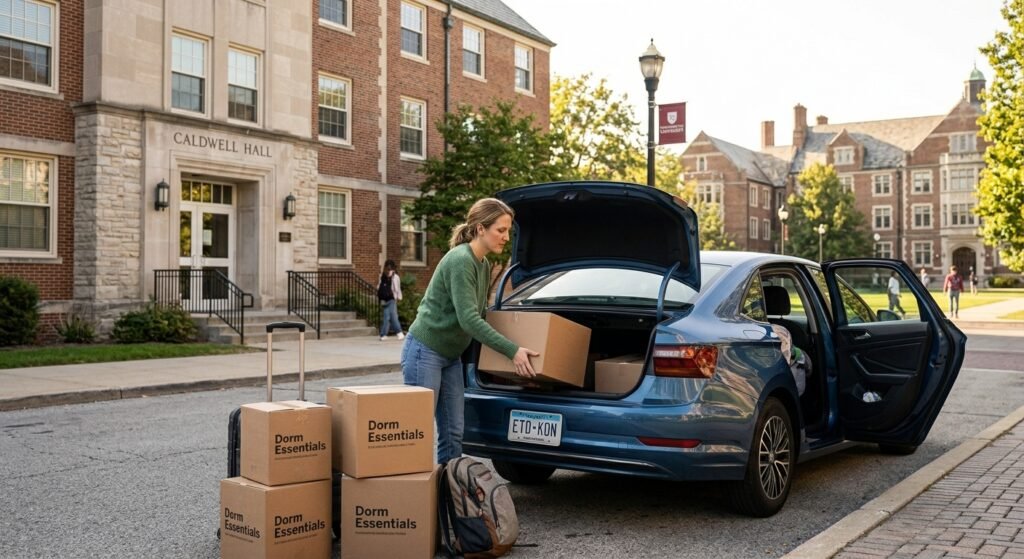
If the Student Is Bringing a Car to Campus
- Confirm coverage requirements at both the home state and the school’s state if they’re different — insurance rules and minimum coverage can vary.
- Check whether the college has any restrictions on where students can park overnight, since campus parking safety can factor into comprehensive coverage risk.
- Consider keeping comprehensive and collision coverage rather than dropping to liability-only, especially in unfamiliar cities with higher accident or theft rates near dense campuses.
Common Mistakes Families Make
Forgetting to update the insurer when a student moves. Even a temporary address change (dorm vs. home) can matter for accurate pricing and coverage — insurers price partly based on where a car is typically parked.
Assuming a good student discount applies automatically. Most insurers require an actual submitted transcript or report card, not just a verbal confirmation of good grades.
Not reviewing coverage before graduation. Once a student graduates and starts working, their driving pattern, address, and sometimes vehicle change — this is a natural point to re-shop coverage rather than letting an old policy auto-renew indefinitely.
Renters Insurance Consideration
Students living off-campus in an apartment (not a dorm) often overlook that their personal belongings may not be covered under a parent’s homeowners policy the way dorm belongings sometimes are. A low-cost renters insurance policy is worth comparing separately from the auto question.
Bottom Line
Most college students save the most money by staying on a family auto policy and claiming every applicable discount — distant student, good student, and multi-vehicle — rather than branching out on their own. The exceptions are graduate students with independent income and older students living entirely separately from family, where a standalone policy may make more practical sense.
Compare auto insurance options for your student’s specific situation.